


Environmental Threats: How Human Activity Is Changing the Planet
Author: Dr. Sonia Mushtaq
Focus Keyword: Environmental Threats
Secondary Keywords: environmental threats to the planet, environmental challenges, climate change, biodiversity loss, planetary boundaries, environmental sustainability, human impact on the environment, sustainable development, environmental threats for businesses, risks and opportunities for businesses, sustainable business practices.
Meta Title:
Environmental Threats: How Human Activity Is Changing the Planet
 Meta Description:
Explore the major environmental threats facing humanity, from climate change and biodiversity loss to water scarcity, pollution, and planetary boundaries.
1. What are environmental threats?
Definition:
Environmental threats are human-induced or human-amplified pressures that degrade natural systems (air, water, soil, biodiversity, climate) and thereby reduce the capacity of the planet to support human well-being now and in the future.
Distinction from natural hazards:
- Natural hazards (earthquakes, volcanic eruptions) arise primarily from natural processes.
- Environmental threats (climate change, pollution, deforestation) are driven largely by human activities and often intensify the impacts of natural hazards (e.g., climate change worsening floods and heatwaves).
In sustainable development, we focus on threats that:
- Are widespread or systemic,
- Have long time horizons (intergenerational impacts), and
- Interact with poverty, inequality, governance—and business models.
2. Why environmental threats matter for sustainable development (and business)
Sustainable development is commonly defined as “meeting the needs of the present without compromising the ability of future generations to meet their own needs.”
Environmental threats directly challenge this by:
- Undermining natural capital: Degraded soils, polluted water, and lost forests reduce the resource base for food, livelihoods, and industry.
- Increasing health burdens: Air pollution, unsafe water, and climate-related disasters cause millions of premature deaths and strain health systems.
- Amplifying inequality: Poor and marginalized communities often live in more polluted areas, depend more on natural resources, and have fewer options to adapt.
- Creating long-term lock-ins: Infrastructure and consumption patterns built today (e.g., coal power, car-dependent cities) can lock in high emissions and pollution for decades.
For business, this means:
- Higher operating costs and supply-chain disruptions.
- Greater regulatory, legal, and reputational exposure.
- Shifting markets and investor expectations.
- New opportunities for innovation, efficiency, and resilience.
Ignoring environmental threats makes “development”—and business growth—fragile, inequitable, and ultimately unsustainable.
3. Major environmental threats (with SDG links, business risks, and business opportunities)
Use this as the core content section. You can present it as a lecture narrative plus a summary table.
3.1 Climate change
What it is:
Long-term shifts in temperature and weather patterns, primarily driven by greenhouse gas emissions from fossil fuels, deforestation, and industrial agriculture.
Key facts:
- Each of the past 11 years (2015–2025) has been among the ten warmest on record.
- Fossil fuels account for about 68% of all greenhouse gas emissions and nearly 90% of CO₂ emissions.
- Climate change intensifies heatwaves, droughts, floods, storms, and sea-level rise.
SDG links:
SDG 13 (Climate Action) is central, but climate change also affects SDG 1 (No Poverty), SDG 2 (Zero Hunger), SDG 3 (Good Health), SDG 6 (Clean Water), SDG 11 (Sustainable Cities), and SDG 15 (Life on Land).
Development implications:
- Reduced agricultural yields and food security in vulnerable regions.
- Increased disaster losses and displacement.
- Higher costs for infrastructure, insurance, and public services.
Business risks
- Physical risks: Damage to factories, warehouses, data centers, retail outlets, and infrastructure from floods, storms, wildfires, and extreme heat.
- Supply-chain risks: Disruptions to agriculture, mining, logistics, and manufacturing from climate-related events.
- Transition risks: Carbon pricing, emission standards, and phase-out policies for high-carbon assets; stranded assets in fossil fuels and high-emission infrastructure.
- Financial risks: Higher cost of capital for high-emission firms; potential devaluation of assets in high-risk regions; increasing insurance costs or loss of coverage.
- Reputational and liability risks: Consumer and investor backlash; litigation over misleading climate claims or failure to manage foreseeable climate risks.
Business opportunities
- Low-carbon products and services: renewable energy, storage, electric vehicles, heat pumps, energy efficiency solutions.
- Efficiency and cost savings from reduced energy and fuel use.
- Climate resilience as a competitive advantage: hardened assets, diversified supply chains, better business continuity planning.
- Improved access to green finance, sustainability-linked loans, and ESG-focused investors.
- Stronger brand and talent attraction by demonstrating climate leadership.
3.2 Air pollution
What it is:
Contamination of indoor and outdoor air by particulate matter (PM₂.₅, PM₁₀), ozone, nitrogen oxides, sulfur dioxide, and other pollutants from vehicles, industry, power plants, biomass burning, and household fuels.
Key facts:
- Air pollution causes around 7 million premature deaths per year globally.
- In 2019, health and economic damages from air pollution were estimated at about US$8.1 trillion (~6.1% of global GDP).
- Children in highly polluted regions may lose up to ~30 months of life expectancy on average.
SDG links:
SDG 3 (Good Health and Well-being), SDG 7 (Affordable and Clean Energy), SDG 11 (Sustainable Cities), SDG 13 (Climate Action).
Development implications:
- Reduced labor productivity and higher healthcare costs.
- Unequal exposure: low-income neighborhoods often face worse air quality.
- Strong co-benefits with climate action (e.g., shifting from coal and diesel improves both health and emissions).
Business risks
- Regulatory and compliance risk from tighter emission standards for vehicles, power plants, and industry.
- Health-related productivity losses and higher healthcare costs for employees in polluted areas.
- Reputational and legal risk from communities and NGOs targeting highly polluting facilities.
- Asset and location risk: facilities in severely polluted areas may face stricter operating constraints and difficulty attracting talent.
Business opportunities
- Clean technology and services: emission-control equipment, monitoring systems, air purifiers, clean cooking solutions.
- Energy transition co-benefits: shifting from coal and diesel to renewables and electrification.
- Healthy buildings and workplaces with better ventilation and filtration, marketed on health and productivity benefits.
- Brand differentiation for companies that proactively reduce air pollution.
3.3 Water pollution and scarcity
What it is:
Degradation of freshwater and marine systems by chemicals, nutrients, pathogens, plastics, and over-extraction, leading to insufficient quantity and quality of water for people and ecosystems.
Key facts:
- Plastic is the most common type of water pollution; millions of tons enter oceans annually.
- Many regions face chronic water stress; pollution further reduces usable water supplies.
- Lack of access to clean water and sanitation remains a major cause of disease, especially for children.
SDG links:
SDG 6 (Clean Water and Sanitation), SDG 3 (Health), SDG 14 (Life Below Water), SDG 15 (Life on Land).
Development implications:
- Limits industrial and agricultural expansion.
- Increases conflict risk over shared water resources.
- Constrains urban growth and public health improvements.
Business risks
- Operational and supply-chain risk in water-intensive sectors (agriculture, textiles, beverages, semiconductors, mining).
- Regulatory and legal risk from stricter limits on water withdrawals and effluent discharges; liability for contamination.
- Community and reputational risk from conflicts over water access and pollution.
- Financial risk: water insecurity linked to stranded assets and higher financing costs in some regions.
Business opportunities
- Water efficiency and recycling technologies that reduce water use per unit of output.
- Water treatment, desalination, leak detection, and smart water management solutions.
- Supply-chain redesign to source from lower-risk regions and work with suppliers on water stewardship.
- Brand and market advantages for “water-positive” or “net-zero water” claims, especially in consumer goods.
3.4 Biodiversity loss and ecosystem degradation
What it is:
Decline in species, genetic diversity, and ecosystem functions due to habitat loss, overexploitation, pollution, invasive species, and climate change.
Key facts:
- Around 1 million species could face extinction in coming decades without action.
- Since 1900, more than 40% of amphibian species have gone extinct.
- Between 1970 and 2021, extreme weather and climate events caused over 2 million deaths and US$4.3 trillion in losses, reflecting ecosystem vulnerability.
SDG links:
SDG 14 (Life Below Water), SDG 15 (Life on Land), plus links to SDG 2 (Food), SDG 1 (Poverty), and SDG 13 (Climate).
Development implications:
- Loss of pollinators, loss of fisheries, and forest products undermine livelihoods.
- Reduced resilience to shocks (e.g., degraded wetlands worsen flooding).
- Cultural and indigenous knowledge tied to ecosystems is eroded.
Business risks
- Dependency risk: many businesses depend directly on ecosystem services (pollination, soil fertility, water regulation, fisheries, timber, raw materials). For example, honey bee populations are declining because of data centers.
- Supply-chain and productivity risk from disruptions to commodity supplies (coffee, cocoa, seafood, timber) due to habitat loss and overexploitation.
- Regulatory, market, and legal risk from emerging rules on deforestation-free supply chains and biodiversity disclosures.
- Financial and valuation risk as nature-related risks affect asset values and portfolio performance.
Business opportunities
- Sustainable sourcing and certification for deforestation-free, biodiversity-friendly supply chains.
- Nature-based solutions: investments in restoration, agroforestry, wetlands, and mangroves that provide carbon sequestration, flood protection, and brand value.
- New products and business models: bio-based materials, regenerative agriculture products, and ecosystem-service-based revenue.
- Improved risk management and resilience by integrating nature risk into enterprise risk management.
3.5 Land degradation and deforestation
What it is:
Loss of soil fertility, structure, and vegetation cover through unsustainable agriculture, logging, mining, urban expansion, and climate change.
Key facts:
- Deforestation contributes about 15% of global greenhouse gas emissions.
- Approximately 12 million hectares of arable land are lost each year to drought and desertification—enough to grow around 20 million tonnes of grain.
SDG links:
SDG 15 (Life on Land), SDG 2 (Zero Hunger), SDG 13 (Climate Action), SDG 1 (No Poverty).
Development implications:
- Reduced agricultural productivity and food insecurity.
- Increased rural poverty and migration.
- Feedbacks to climate change via carbon release and reduced carbon sinks.
Business risks
- Resource scarcity and cost risk from reduced agricultural productivity and raw material availability.
- Regulatory and market access risk from restrictions on commodities linked to deforestation.
- Reputational and legal risk from associations with land grabs, indigenous rights violations, or forest loss.
- Physical risk from soil erosion, dust storms, and reduced water retention increasing vulnerability to droughts and floods.
Business opportunities
- Regenerative agriculture and sustainable forestry practices that restore soil health and sequester carbon.
- Traceability and transparency solutions: satellite monitoring, blockchain, and certification for deforestation-free supply chains.
- Land restoration businesses offering restoration services, carbon and biodiversity projects, and blended finance structures.
- Long-term security of supply by investing in sustainable land management.
3.6 Ocean acidification, marine pollution, and overfishing
What it is:
Oceans absorb about 30% of emitted CO₂, lowering pH (acidification), while also facing plastic pollution, chemical runoff, and overexploitation of fish stocks.
Key facts:
- Ocean acidification threatens coral reefs, shellfish, and food webs.
- Global sea level is rising about 3.2 mm per year, potentially displacing 340–480 million people this century.
SDG links:
SDG 14 (Life Below Water), SDG 13 (Climate Action), SDG 2 (Food), SDG 8 (Decent Work) for fishing communities.
Development implications:
- Threatens coastal economies, tourism, and fisheries.
- Increases vulnerability of small island and low-lying coastal states.
Business risks
- Fisheries and aquaculture risk from declining fish stocks and changing species distributions.
- Coastal infrastructure and tourism risk from sea-level rise, storm surges, and coral reef degradation.
- Regulatory and market risk from stricter rules on plastics, packaging, and unsustainable seafood.
- Reputational risk due to high visibility of plastic pollution and ocean damage.
Business opportunities
- Sustainable seafood and aquaculture innovation, including alternative proteins.
- Plastic alternatives and improved waste management systems.
- Coastal resilience and blue economy investments (mangrove restoration, reef protection, climate-resilient infrastructure).
- Brand leadership for companies that adopt ocean-friendly practices.
3.7 Waste and chemical pollution (including plastics)
What it is:
Accumulation of solid waste (especially plastics), electronic waste, and hazardous chemicals in landfills, rivers, oceans, and soils.
Key facts:
- Plastic is the most common form of water pollution and a growing component of municipal waste.
- Fast fashion and high-consumption lifestyles accelerate waste generation and resource depletion.
SDG links:
SDG 12 (Responsible Consumption and Production), SDG 6 (Water), SDG 14 (Oceans), SDG 3 (Health).
Development implications:
- Health risks from burning waste and leaching chemicals.
- Economic costs of waste management and cleanup.
- Opportunities for circular economy and green jobs if addressed proactively.
Business risks
- Regulatory and compliance risk from extended producer responsibility laws, plastic taxes, bans on single-use items, and chemical restrictions.
- Cost and liability risk from rising waste management and cleanup costs and contamination liabilities.
- Reputational and market risk from consumer and investor pressure on visible waste and toxic products.
Business opportunities
- Circular economy models: reuse, repair, remanufacturing, recycling, product-as-a-service, take-back schemes, and resale platforms.
- Eco-design and material innovation for durability, modularity, and recyclability; development of safer, non-toxic materials.
- Waste-to-resource businesses converting waste into inputs (recycled plastics, compost, energy from organic waste).
- Cost savings and brand value from reduced waste and fewer hazardous chemicals.
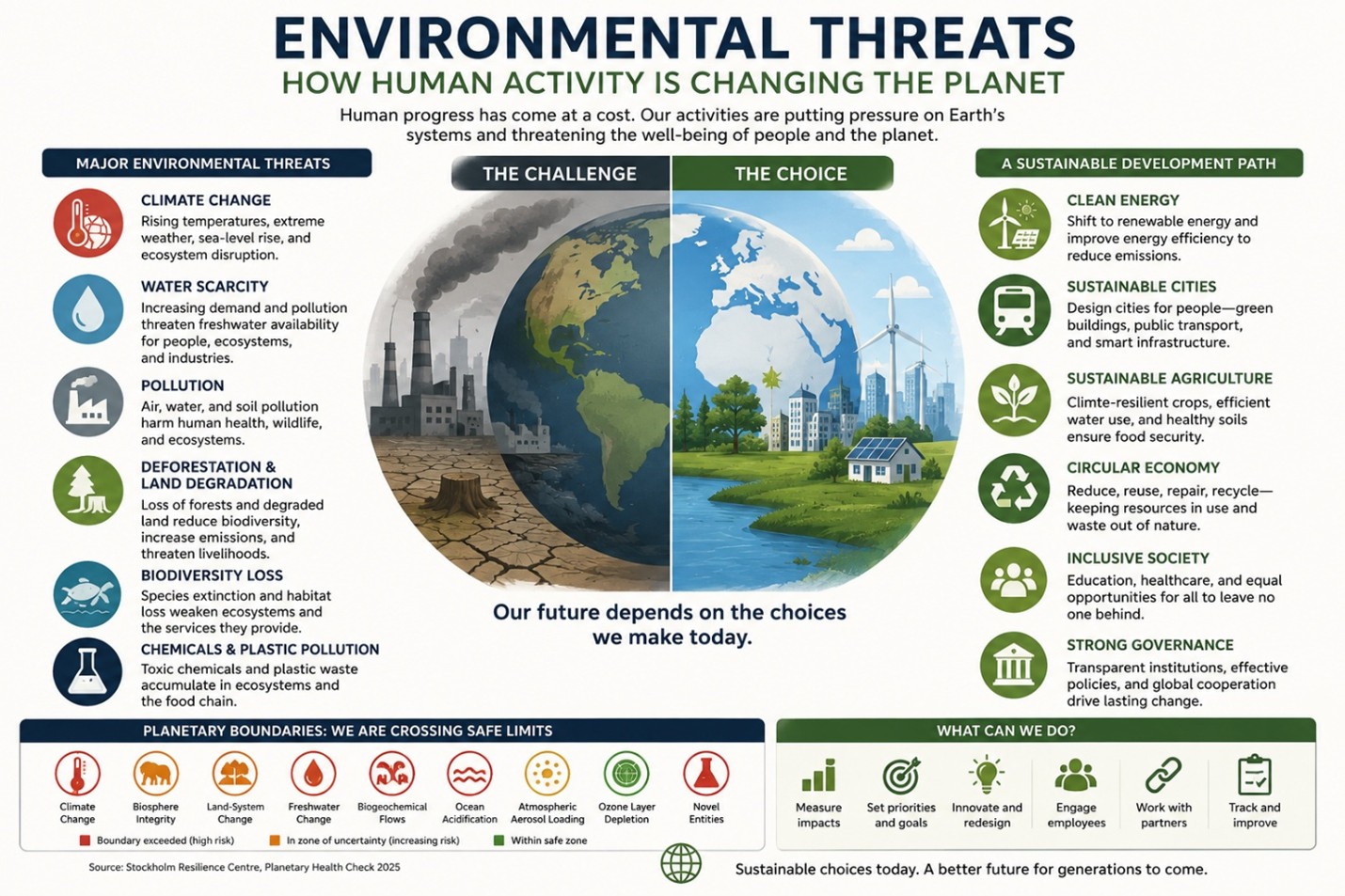
5. Planetary boundaries: the science of global limits
What are planetary boundaries?
The planetary boundaries framework identifies nine key Earth-system processes that regulate the stability and resilience of the planet. For each process, scientists propose a quantitative boundary—a “safe operating space” for humanity—beyond which the risk of abrupt, large-scale, and potentially irreversible environmental change increases sharply.
The nine boundaries typically include:
- Climate change
- Biosphere integrity (biodiversity loss and extinctions)
- Land-system change (deforestation and land conversion)
- Freshwater use (and increasingly, freshwater change more broadly)
- Biogeochemical flows (nitrogen and phosphorus cycles)
- Ocean acidification
- Atmospheric aerosol loading
- Chemical pollution and release of novel entities (e.g., plastics, synthetic chemicals)
- Stratospheric ozone depletion (largely improved due to global action)
6. Responses: Mitigation, adaptation, and transformation (with business lens)
Structure this as “what can be done” at different levels.
6.1 Mitigation (reducing the threats)
Examples:
- Shifting from fossil fuels to renewable energy and electrified transport.
- Improving energy efficiency in buildings and industry.
- Protecting and restoring forests, wetlands, and soils as carbon sinks.
- Reducing waste and moving toward circular economy models.
Business angle:
- Lower emissions and pollution reduce regulatory and transition risks.
- Efficiency measures cut operating costs.
- Early movers in low-carbon technologies can capture new markets and set standards.
6.2 Adaptation (coping with unavoidable impacts)
Examples:
- Climate-resilient infrastructure (flood defenses, heat-resistant design).
- Drought-tolerant crops and improved water management.
- Early warning systems for extreme weather and disasters.
- Protecting and restoring ecosystems that buffer hazards (mangroves, reefs, forests).
Business angle:
- Adaptation reduces physical risks to assets and supply chains.
- Resilient operations maintain continuity and protect revenues during shocks.
- Companies that help others adapt (infrastructure, insurance, analytics) can develop new business lines.
6.3 Transformational change
Beyond incremental fixes:
- Rethinking consumption patterns and lifestyles (e.g., less meat, less fast fashion, more shared mobility).
- Integrating environmental costs into economic decisions (carbon pricing, pollution taxes, extended producer responsibility).
- Strengthening governance, participation, and justice so that responses are equitable and politically durable.
Business angle:
- Transformational change can redefine industries (e.g., from ownership to access, from linear to circular).
- Companies that lead transformation can shape regulations, standards, and customer expectations in their favor.
- Sustainable development is not just “green growth”; it may require structural changes in business models, value chains, and corporate governance.
7. Key takeaways
- Environmental threats are central, not peripheral, to sustainable development; they shape what kinds of development—and business models—are possible and durable.
- The major threats—climate change, pollution, water stress, biodiversity loss, land degradation, ocean change, and waste—are deeply interconnected and linked to multiple SDGs.
- Each threat creates specific business risks (physical, transition, liability, reputational, supply-chain, financial) and business opportunities (efficiency, innovation, resilience, new markets, access to capital).
- Addressing these threats requires a mix of mitigation, adaptation, and transformational changes across energy, land use, cities, industry, and consumption.
- Sustainable development is fundamentally about choices: the technologies we deploy, the institutions we build, the policies we adopt, and the business strategies we pursue will determine whether development is inclusive and resilient or fragile and short-lived.