


Workplace mental health is no longer simply an employee benefit or an HR issue. The conditions under which people work, including workload, job security, relationships with managers, psychological safety, flexibility, recognition, and growth opportunities, can influence employee well-being and organizational sustainability.
For U.S. employers, the challenge is increasingly moving beyond offering an Employee Assistance Program (EAP) or occasional wellness activities. A sustainable approach addresses the work environment itself while ensuring employees can access appropriate support when they need it.
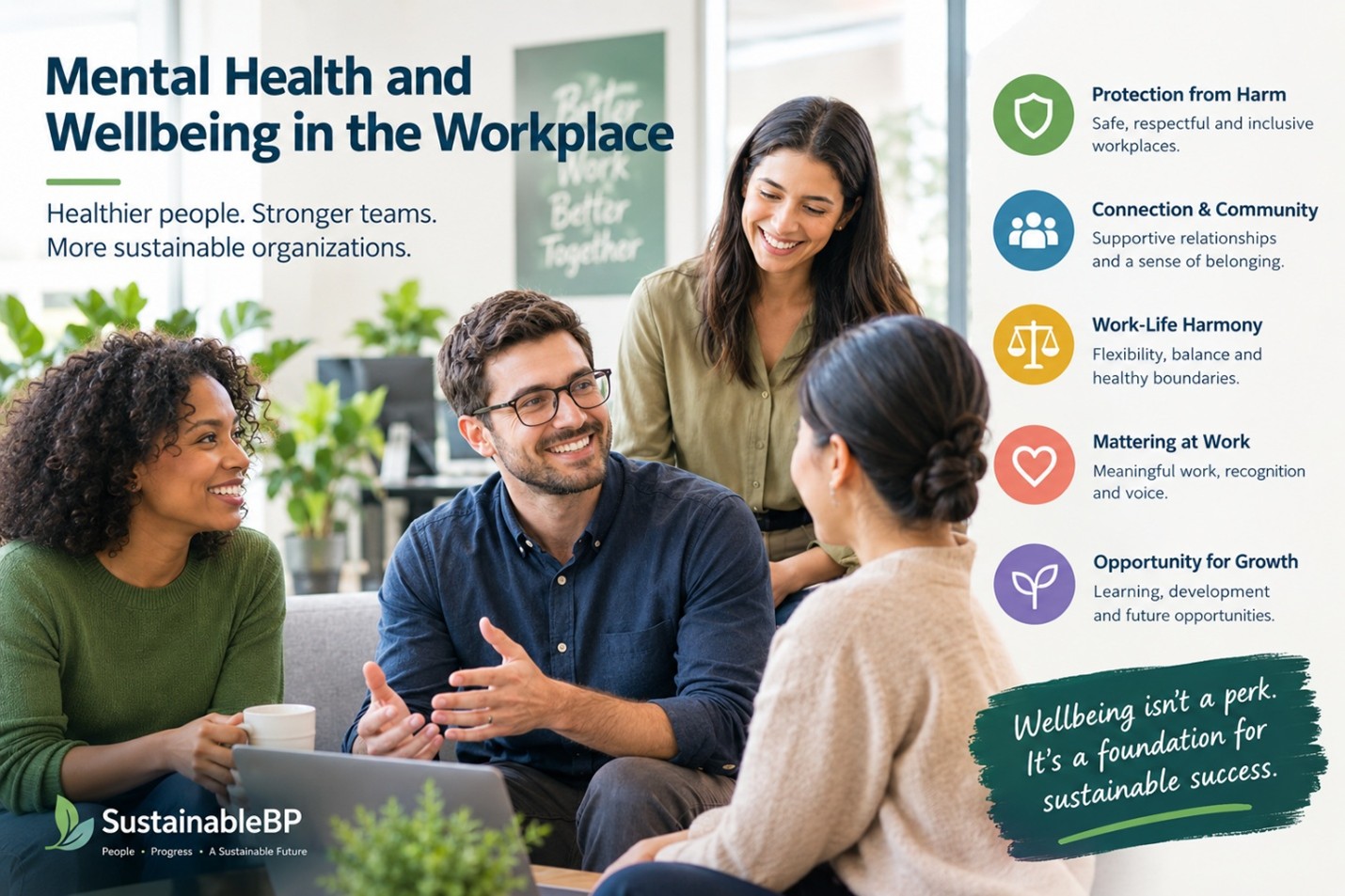
The U.S. Surgeon General’s Framework for Workplace Mental Health and Well-Being identifies five essentials for healthier workplaces: Protection from Harm, Connection and Community, Work-Life Harmony, Mattering at Work, and Opportunity for Growth.
Why Workplace Mental Health Matters
Work occupies a significant part of adult life, making the workplace an important setting for supporting mental health and wellbeing.
The National Institute for Occupational Safety and Health (NIOSH) notes that work can have a substantial influence on workers’ mental health and that chronic exposure to occupational stress can worsen mental health. Workplace factors such as high job demands, limited resources or control, long working hours, and workplace violence can contribute to mental health challenges.
This creates an important distinction.
Organizations cannot control every factor affecting an employee’s mental health. But they can influence the conditions in which people work.
That means workplace mental health should not be reduced to asking employees to become more resilient. Employers also need to examine whether the organization itself is creating unnecessary sources of stress.
A sustainable workplace therefore asks two questions:
- How can we support employees who are experiencing mental health challenges?
- How can we design work so that unnecessary psychological and social stressors are reduced?
Both questions matter.
Mental Health Is Part of Sustainable Business
Sustainability is often discussed in terms of emissions, energy efficiency, waste reduction, and climate risk. These issues are important, but sustainability also has a people dimension.
An organization cannot meaningfully discuss long-term sustainability while ignoring the conditions experienced by its workforce.
This is where social sustainability becomes important.
Social sustainability focuses on issues such as:
- Employee wellbeing
- Fair and respectful treatment
- Health and safety
- Inclusion
- Decent work
- Psychological safety
- Work-life balance
- Employee development
- Meaningful work
- Community and stakeholder relationships
Mental health and wellbeing therefore have a natural connection with Sustainable Human Resource Management (Sustainable HRM).
Rather than treating employees as a resource to be optimized indefinitely, Sustainable HRM considers how organizations can create value for both the organization and the people who work within it.
The U.S. Workplace Mental Health Context
Recent U.S. evidence illustrates why organizations need to take workplace wellbeing seriously.
The American Psychological Association’s 2025 Work in America survey, conducted among more than 2,000 working adults in the United States, found that 54% of workers said job insecurity had a significant impact on their stress levels. The survey also examined how economic uncertainty, workplace changes, technology, and organizational changes affect employees’ psychological and emotional wellbeing.
The survey also found an association between employees’ relationships with managers and their reported workplace experiences. Workers who were satisfied with their relationship with their manager were less likely to describe their workplace experience as toxic and were less likely to report concerns about job insecurity.
These findings point to an important principle:
Employee wellbeing is shaped not only by individual coping strategies but also by organizational conditions.
This is why workplace mental health should be considered a leadership and organizational-design issue as well as an HR issue.
What Is Workplace Mental Health?
Workplace mental health refers broadly to the psychological and emotional wellbeing of people in relation to their work and working environment.
It includes more than the absence of mental illness.
A psychologically healthy workplace can support:
- A sense of safety
- Positive relationships
- Meaningful work
- Reasonable work demands
- Autonomy and control
- Belonging
- Recognition
- Development
- Work-life integration
- Access to appropriate support
At the same time, mental health is highly individual. Employees may experience anxiety, depression, stress, grief, trauma, burnout, substance-use challenges, or other difficulties for reasons both inside and outside the workplace.
Employers should therefore avoid trying to diagnose employees.
The organizational responsibility is to create healthy working conditions, reduce avoidable workplace stressors, provide appropriate resources, and ensure employees know where they can seek professional support.
The Five Essentials of Workplace Wellbeing
The U.S. Surgeon General’s Framework provides a useful structure for organizations seeking to improve workplace mental health.
1. Protection from Harm
Psychological wellbeing requires a workplace where employees are protected from physical and non-physical harm.
This includes addressing:
- Bullying
- Harassment
- Discrimination
- Workplace violence
- Unsafe working conditions
- Excessive or chronic workplace stress
- Insecure or unpredictable working conditions where organizationally addressable
The framework places safety and security at the foundation of workplace wellbeing.
For HR leaders, this means that mental health cannot be separated from workplace policies and organizational practices.
An organization that provides meditation sessions while ignoring harassment, chronic understaffing, or unreasonable workloads is addressing only part of the problem.
2. Connection and Community
People need healthy relationships and a sense of belonging.
Workplaces can support connection by creating opportunities for:
- Team collaboration
- Respectful communication
- Peer support
- Inclusive participation
- Mentoring
- Manager-employee dialogue
- Social connection
Connection does not mean forcing employees to participate in social activities.
Instead, it means creating conditions where employees can develop respectful and supportive relationships.
Managers play an especially important role because employees experience organizational culture partly through their day-to-day interactions with supervisors.
3. Work-Life Harmony
Work should have a sustainable place in people’s lives.
Organizations can support work-life harmony through practices such as:
- Reasonable workload management
- Predictable scheduling where possible
- Flexible work arrangements where appropriate
- Adequate rest
- Paid leave
- Respect for non-work time
- Family-supportive practices
- Clear expectations about availability
The issue is not simply whether employees work remotely or in an office.
The APA’s 2025 research suggests that neither in-person nor remote nor hybrid work is inherently better for every worker. Rather, workers may experience psychological benefits when their work arrangements align with their preferences and circumstances.
For organizations, the implication is that flexibility should be considered thoughtfully rather than treated as a one-size-fits-all solution.
4. Mattering at Work
Employees want to feel that their work has value.
The Surgeon General’s framework emphasizes the importance of helping workers feel valued, respected, and connected to organizational purpose.
Organizations can strengthen this sense of mattering through:
- Meaningful recognition
- Fair treatment
- Employee voice
- Constructive feedback
- Connecting individual roles with organizational purpose
- Recognizing contributions
- Giving employees opportunities to participate in decisions affecting their work
This has a direct connection with Sustainable HRM.
If sustainability is part of an organization’s purpose, employees should be able to understand how their individual work contributes to that purpose.
5. Opportunity for Growth
Learning and development can contribute to both employee wellbeing and organizational sustainability.
Organizations can provide:
- Training and development
- Career opportunities
- Mentoring
- Skills development
- Constructive feedback
- Career conversations
- Opportunities to take on meaningful responsibilities
This is particularly important as workplaces undergo technological, environmental, and economic change.
Sustainability itself is generating new skills requirements. Employees increasingly need opportunities to develop capabilities related to climate, sustainability, technology, responsible business, and organizational change.
Investment in people can therefore serve both employee wellbeing and organizational resilience.
Why “Self-Care” Alone Is Not a Mental Health Strategy
One of the most common approaches to workplace wellbeing is to focus heavily on individual self-care.
Examples include:
- Meditation apps
- Wellness newsletters
- Exercise challenges
- Resilience workshops
- Mindfulness sessions
These initiatives can be useful.
But they should not become substitutes for addressing organizational stressors.
NIOSH recommends a broader approach that considers workplace conditions and healthy work design, while OSHA similarly emphasizes identifying and reducing workplace stressors alongside providing coping and resilience resources.
Consider an organization where employees routinely work excessive hours because positions remain unfilled.
Providing a meditation app may give employees another coping resource.
But addressing staffing, workload, scheduling, and management practices addresses the source of the organizational stress.
This distinction is fundamental to sustainable workplace wellbeing.
What Can HR Do?
Human Resources can play an important role in developing a systematic approach to workplace mental health.
1. Assess workplace conditions
Before introducing another wellness program, ask employees what is actually affecting their wellbeing.
Potential areas include:
- Workload
- Working hours
- Manager support
- Job control
- Psychological safety
- Recognition
- Career development
- Compensation and benefits
- Job security
- Work-life boundaries
- Workplace relationships
NIOSH’s Worker Well-Being Questionnaire (WellBQ) is one established tool for assessing worker wellbeing across multiple dimensions, including work life, circumstances outside work, and physical and mental health. The questionnaire was revised by NIOSH in June 2026.
2. Train managers
Managers often have substantial influence over employees’ everyday experience of work.
Managers should know how to:
- Recognize potential signs that an employee may be struggling
- Have respectful conversations
- Listen without attempting to diagnose
- Discuss workload and workplace stress
- Encourage appropriate professional support
- Respect confidentiality
- Apply policies consistently
- Escalate safety concerns appropriately
Managers should not be expected to become therapists.
Their role is to create a healthy work environment and respond appropriately when concerns arise.
3. Review workload and job design
A wellbeing strategy should examine how work is actually designed.
Ask:
Are workloads realistic?
Do employees have enough resources to perform their jobs?
Do employees have reasonable control over how they complete their work?
Are priorities clear?
Are employees expected to remain continuously available?
Are staffing levels adequate?
These questions move workplace wellbeing from an individual-level intervention to an organizational-level strategy.
4. Strengthen psychological safety
Psychological safety means employees can raise concerns, ask questions, admit mistakes, and offer ideas without unreasonable fear of humiliation or retaliation.
Organizations can support psychological safety through:
- Respectful communication
- Open discussion of problems
- Constructive responses to mistakes
- Employee voice
- Inclusive meetings
- Manager training
- Consistent treatment
Psychological safety does not mean eliminating accountability.
A psychologically safe organization can maintain high standards while allowing employees to communicate honestly about problems.
5. Make mental health resources accessible
Organizations can provide appropriate resources such as:
- Employee Assistance Programs
- Mental health benefits
- Health insurance coverage
- Counseling referrals
- Crisis resources
- Leave policies
- Flexible work arrangements where appropriate
- Mental health education
However, employees should not be pressured to disclose private medical information to managers or colleagues.
The goal is to make support accessible, trustworthy, and voluntary.
Employee Wellbeing Should Be Measured
If wellbeing is considered part of organizational sustainability, organizations need ways to understand whether their efforts are making a difference.
Possible indicators include:
Employee-level measures
- Perceived wellbeing
- Psychological safety
- Work-life balance
- Job satisfaction
- Sense of belonging
- Perceived manager support
- Burnout-related indicators
Organizational indicators
- Absenteeism
- Turnover
- Employee engagement
- Use of wellbeing resources
- Safety incidents
- Employee assistance utilization trends, where appropriately aggregated and privacy-protected
- Internal mobility
- Training participation
- Workload indicators
Measurement should be designed carefully.
Organizations should avoid turning mental health data into a surveillance mechanism.
Privacy, confidentiality, informed participation, and appropriate aggregation are essential.
A Sustainable Employee Wellbeing Framework
SustainableBP proposes thinking about employee wellbeing through five connected levels:
1. Prevent
Identify and reduce avoidable workplace stressors.
2. Protect
Provide safe, respectful, inclusive working conditions.
3. Support
Ensure employees can access appropriate mental health and wellbeing resources.
4. Develop
Invest in learning, skills, career development, resilience, and meaningful work.
5. Measure
Use appropriate data and employee feedback to understand whether workplace conditions are improving.
The model can be summarized as:
Prevent → Protect → Support → Develop → Measure
This approach positions wellbeing as an ongoing organizational process rather than a once-a-year wellness campaign.
From Employee Wellness to Sustainable Wellbeing
There is an important difference between employee wellness programs and sustainable employee wellbeing.
A wellness program might provide a set of activities.
Sustainable wellbeing asks whether the organization’s systems, policies, leadership and work design support people over time.
| Traditional Wellness Approach | Sustainable Wellbeing Approach |
| Focuses mainly on individuals | Considers individuals and systems |
| Emphasizes coping | Addresses workplace stressors |
| Often program-based | Integrated into organizational practices |
| May focus on short-term activities | Focuses on long-term conditions |
| Often owned by HR | Shared by leadership, managers and HR |
| Measures participation | Measures conditions and outcomes |
| May emphasize self-care | Combines self-care with organizational responsibility |
The two approaches do not have to compete.
Wellness resources can be valuable. But they become more meaningful when combined with healthy work design, supportive leadership, psychological safety, fair policies, and access to professional care.
The Role of Sustainable HRM
Sustainable Human Resource Management provides a useful way to connect employee wellbeing with organizational sustainability.
A Sustainable HRM approach can incorporate wellbeing into:
- Recruitment
- Onboarding
- Training and development
- Performance management
- Leadership development
- Employee relations
- Compensation and benefits
- Workforce planning
- Career development
- Organizational culture
For example:
Recruitment: Set realistic job expectations.
Onboarding: Introduce employees to wellbeing resources and support systems.
Training: Equip managers to recognize and respond appropriately to workplace stress.
Performance management: Avoid creating incentives for chronically unsustainable workloads.
Leadership: Include employee wellbeing in leadership expectations.
Workforce planning: Consider workload and staffing requirements.
Employee voice: Regularly seek feedback about workplace conditions.
This is where mental health moves from being an isolated HR initiative to becoming part of sustainable organizational practice.
What Sustainable Organizations Should Ask
Every organization can begin with a relatively simple set of questions:
Work design
- Are workloads manageable?
- Are priorities clear?
- Do employees have adequate resources?
Leadership
- Do managers communicate respectfully?
- Can employees raise concerns safely?
- Are managers equipped to support employee wellbeing?
Culture
- Are bullying and harassment addressed?
- Do employees feel respected?
- Do people feel that their work matters?
Flexibility
- Are work arrangements designed around both organizational and employee needs?
- Are employees able to disconnect from work appropriately?
Development
- Do employees have opportunities to learn and grow?
- Are sustainability-related skills being developed?
Support
- Can employees easily find mental health resources?
- Are support systems confidential and accessible?
Measurement
- Does the organization listen to employees?
- Are wellbeing indicators monitored responsibly?
- Are interventions adjusted based on evidence?
These questions can help organizations move from wellness programs to wellbeing strategy.
The Business Case Should Not Replace the Human Case
There is also a business argument for workplace wellbeing.
OSHA notes that workplace stress and poor mental health can affect performance, productivity, engagement, communication, and physical functioning. Its employer guidance recommends addressing workplace stressors while also providing coping, resilience, and support resources.
But organizations should be careful about framing employee mental health solely in terms of productivity.
People are not simply economic inputs.
A sustainable organization considers employee wellbeing as a legitimate organizational and human objective in its own right.
Productivity, retention, engagement and organizational resilience can be important outcomes—but they should complement, rather than replace, the responsibility to create healthy and respectful working conditions.
Building a Sustainable Workplace Mental Health Strategy
A practical strategy can follow seven steps:
Step 1: Listen
Collect employee feedback about workplace conditions and wellbeing.
Step 2: Identify
Identify organizational sources of unnecessary stress.
Step 3: Prioritize
Focus on the most significant and addressable issues.
Step 4: Design
Develop policies and practices addressing workload, flexibility, management, safety, development and support.
Step 5: Equip
Train managers and provide employees with appropriate resources.
Step 6: Measure
Monitor wellbeing and organizational indicators while protecting employee privacy.
Step 7: Improve
Use employee feedback and evidence to continuously improve the workplace.
This makes wellbeing part of a continuous organizational improvement process rather than a temporary campaign.
Conclusion
Mental health and wellbeing are increasingly important dimensions of sustainable work.
For U.S. organizations, current evidence points to the importance of workplace conditions—including job security, management relationships, work arrangements, psychological safety, and access to support.
The central question is therefore not simply:
“How can we make employees more resilient?”
A more sustainable question is:
“How can we design work and workplaces in ways that allow people to remain healthy, supported, engaged, and able to contribute over the long term?”
That shift—from individual coping to organizational responsibility—places mental health within the broader concept of social sustainability.
For Sustainable HRM, this is particularly important. Organizations that want sustainable performance need sustainable approaches to people.
Healthy people, healthy workplaces, and sustainable organizations are interconnected.
Frequently Asked Questions
What is workplace mental health?
Workplace mental health refers to employees’ psychological and emotional wellbeing in relation to their work and working environment. It includes factors such as stress, psychological safety, relationships, workload, work-life harmony, belonging, meaningful work and access to appropriate support.
Why is employee wellbeing important for sustainability?
Employee wellbeing is part of the social dimension of sustainability. Organizations depend on people to create and maintain long-term value, making healthy working conditions, employee development, safety, inclusion and wellbeing relevant to sustainable organizational performance.
What can employers do to support mental health?
Employers can identify and reduce workplace stressors, improve job design, train managers, strengthen psychological safety, provide appropriate mental health resources, support work-life harmony, and regularly seek employee feedback.
Is an Employee Assistance Program enough?
An EAP can be an important support resource, but it should not be the entire workplace mental health strategy. Organizations should also examine workplace conditions such as workload, management practices, job design, psychological safety, flexibility and organizational culture.
How can HR measure employee wellbeing?
Organizations can use employee surveys and validated assessment tools, alongside indicators such as absenteeism, turnover, engagement, psychological safety and perceptions of manager support. NIOSH’s Worker Well-Being Questionnaire is one established option for assessing worker wellbeing across multiple dimensions.
What is the connection between Sustainable HRM and employee wellbeing?
Sustainable HRM integrates long-term employee and organizational wellbeing into HR practices such as recruitment, development, performance management, leadership, workforce planning and employee relations.
Important Note
Workplace wellbeing information is educational and organizational in nature. It is not a substitute for professional mental health assessment, diagnosis, treatment, or emergency assistance. Organizations should provide employees with appropriate access to qualified healthcare and mental health professionals when needed.