


What Is Poverty? Understanding Poverty and Sustainable Development
Author: Dr. Sonia Mushtaq
Focus Keyword: What Is Poverty?
Secondary Keywords: extreme poverty, poverty and sustainable development, causes of poverty, multidimensional poverty, global poverty, poverty reduction, sustainable development and poverty
Meta Title: What Is Poverty? Understanding Poverty and Sustainable Development
Meta Description: What is poverty, and why does it persist despite global economic growth? Explore extreme poverty, multidimensional poverty, inequality, geography, and sustainable solutions.
What Is Poverty?
The world has created extraordinary wealth. Economies have expanded, technology has transformed lives, medical knowledge has advanced, and millions of people have moved into higher-income categories. Yet poverty remains one of the world’s major sustainable development challenges.
This raises an important question:
If the world has become richer, why do millions of people still struggle to meet their basic needs?
The answer begins with recognizing that poverty is much more than a lack of money.
A person may experience poverty because of insufficient income, but poverty can also involve limited access to clean water, sanitation, electricity, healthcare, education, safe housing, nutritious food, decent employment, and opportunities to improve their circumstances.
This broader understanding is essential to sustainable development. The goal is not simply to increase national income; it is to create societies in which people can live healthy, secure, productive, and dignified lives.
Understanding the Different Forms of Poverty
Poverty can be understood in several ways.
Absolute poverty refers to a severe lack of basic resources required for survival, such as adequate food, clean water, and safe shelter.
Relative poverty refers to having insufficient resources to maintain the standard of living considered normal within a particular society.
Multidimensional poverty goes beyond income and considers deprivations in areas such as education, healthcare, sanitation, drinking water, electricity, and other essential services.
This distinction matters because two households with similar incomes may experience very different living conditions. One may have safe housing, clean water, electricity, good schools, and nearby healthcare, while another may lack these basic services.
Poverty is therefore not simply about how much money a person has. It is also about what opportunities and basic services that person can access.
How Is Extreme Poverty Measured?
The World Bank updated its international poverty lines in 2025. The international extreme-poverty line is currently $3.00 per person per day, based on 2021 purchasing power parities. It also uses higher lines of $4.20 for lower-middle-income economies and $8.30 for upper-middle-income economies.
These international lines are useful for comparing poverty across countries, but they do not replace national poverty measures.
Extreme poverty is associated with an inability to meet basic material needs. For households experiencing extreme poverty, everyday concerns may include:
- Is there enough food today?
- Is drinking water safe?
- Can a sick family member receive treatment?
- Can children attend school?
- Is there electricity and safe sanitation?
- Is there secure housing?
- Can the household survive the loss of income or a failed harvest?
This is why poverty should be understood as a human development challenge, not simply as a statistical category.
Global Poverty in a World of Plenty
The world has made substantial progress in reducing extreme poverty. Millions of people, particularly in East Asia and parts of South Asia, have moved out of extreme poverty through a combination of economic growth, education, infrastructure, technological progress, improved health systems, and development efforts.
However, progress has not been evenly distributed. Under the World Bank’s updated $3.00-a-day measure, around one in ten people globally are estimated to remain in extreme poverty. Poverty is increasingly concentrated in low-income, fragile, conflict-affected, and highly vulnerable settings.
The important lesson is:
Global poverty has declined, but progress has not been evenly distributed.
This changing geography of poverty means that poverty-reduction strategies cannot rely on a single universal approach. Different communities face different combinations of economic, environmental, institutional, and social constraints.
The Rural and Urban Faces of Poverty
Poverty has both rural and urban dimensions.
Rural Poverty
For many rural households, particularly smallholder farmers, livelihoods depend directly on natural resources and agriculture. Limited rainfall, drought, poor soil, inadequate irrigation, weak transportation, limited market access, lack of technology, restricted access to credit, and inadequate healthcare and education can all constrain economic opportunity.
A single environmental shock can therefore become an economic crisis.
A failed harvest can mean less food. Less food can contribute to malnutrition. Lower agricultural income can prevent children from remaining in school, while illness can further reduce household income.
This illustrates how economic, social, environmental, and health factors can interact to reinforce poverty.
Urban Poverty
Poverty is not only a rural phenomenon. Rapid urbanization has created economic opportunities, but many people move to cities without access to adequate housing, infrastructure, or formal employment.
Urban poverty may involve:
- Unsafe or inadequate housing
- Poor sanitation
- Limited clean water
- Unreliable electricity
- Weak waste collection
- Limited healthcare
- Poor public transportation
- Insecure employment
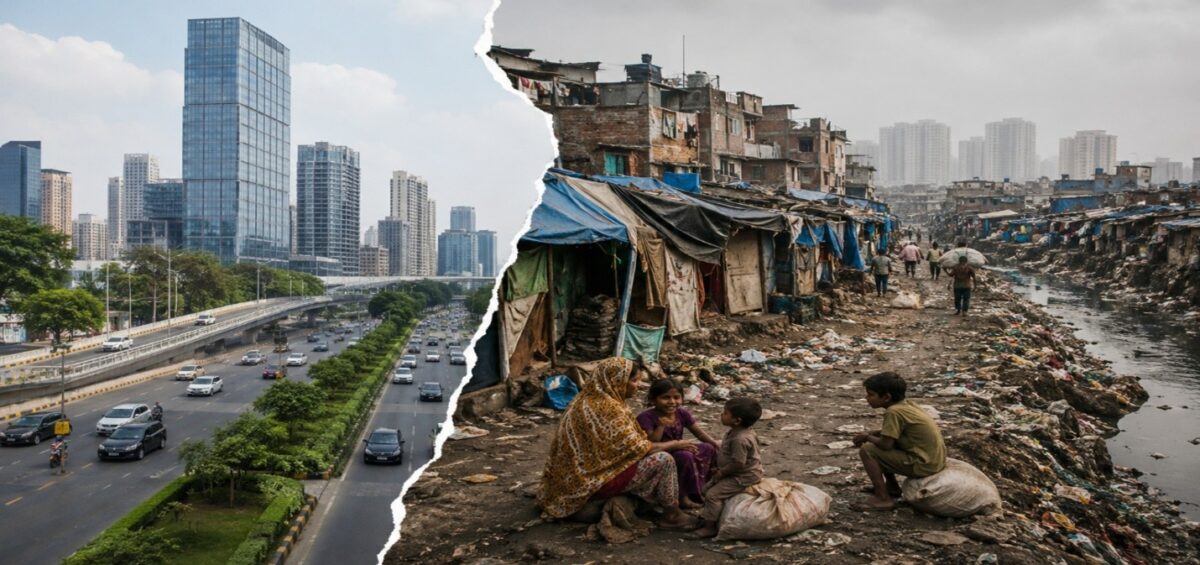
One of the striking characteristics of urban poverty is that it can exist next to enormous wealth. A city may contain modern offices, luxury housing, technology companies, and sophisticated infrastructure while nearby communities struggle to meet basic needs.
Poverty, Geography, and Vulnerability
Geography can shape the opportunities and constraints faced by communities.
Coastal and landlocked regions, fertile and arid areas, connected and isolated communities, and stable and conflict-affected regions may face very different economic conditions.
Geography can influence:
- Access to markets and trade
- Agricultural productivity
- Climate exposure
- Transportation costs
- Disease exposure
- Access to infrastructure
- Economic opportunities
Geography does not determine people’s futures, but it can influence the conditions within which households and economies operate.
The growing concentration of poverty in vulnerable regions also highlights the importance of context-specific solutions rather than assuming that an approach that worked in one country will produce the same results elsewhere.
Poverty, Health, and Education
Poverty and health are closely connected. People living in poverty may face greater exposure to malnutrition, unsafe water, poor sanitation, infectious diseases, inadequate housing, pollution, and limited healthcare.
At the same time, illness can push households deeper into poverty through:
Medical expenses + lost income + reduced productivity + increased vulnerability.
This creates a poverty-health cycle.
Improving access to healthcare is therefore an important part of poverty reduction. Technology can also extend access through telemedicine, mobile health services, digital health records, remote diagnostics, and community-based healthcare—provided these solutions are affordable and accessible.
Education is equally important.
Quality education can develop skills that improve future employment and income opportunities and can help break the intergenerational transmission of poverty. Yet poverty itself can prevent children from accessing education because families may struggle with school costs, transportation, books, technology, nutrition, or the opportunity cost of children’s time.
This creates a cycle:
Poverty → limited educational opportunity → limited skills → limited employment opportunities → continued poverty.
Sustainable development seeks to break this cycle through education, decent work, economic opportunity, and social protection.
Poverty and the Environment
Poverty also has an important environmental dimension.
Many vulnerable communities depend directly on natural resources. Farmers depend on soil and water, fishing communities depend on healthy rivers and oceans, and some rural households depend on forests and other natural resources.
When ecosystems deteriorate, these communities can suffer disproportionately.
At the same time, poorer households often have fewer resources to adapt to environmental shocks. A wealthier household may be able to repair a damaged home, purchase insurance, relocate temporarily, or invest in climate-resilient infrastructure. A poor household may have very limited options.
Consequently, poverty, climate vulnerability, and environmental degradation can reinforce one another. Sustainable development therefore requires poverty reduction and environmental protection to be pursued together.
Poverty and Inequality Are Not the Same
Poverty and inequality are related but different concepts.
Poverty asks:
Does a person have enough resources and opportunities to meet basic needs?
Inequality asks:
How are income, wealth, opportunities, and resources distributed across people or groups?
A country can reduce extreme poverty while still experiencing substantial inequality. Economic growth may increase average income while some communities benefit much more than others.
This is why sustainable development is concerned not only with poverty reduction but also with social inclusion and access to opportunity.
Can Economic Growth Eliminate Poverty?
Economic growth can play an important role in poverty reduction. When economies grow in ways that create productive employment, raise incomes, improve infrastructure, and expand public resources, people can gain opportunities to move out of poverty.
However, growth alone does not guarantee that everyone benefits.
The quality and inclusiveness of growth matter. Growth accompanied by decent employment, education, healthcare, infrastructure, social protection, entrepreneurship, and equal opportunity can contribute to broader poverty reduction.
This connects directly with the previous Insight in this series:
[Economic Growth and Progress: Can Economic Development Be Sustainable?]
Economic development becomes more meaningful when improvements in economic output translate into improvements in people’s lives.
Poverty and Sustainable Development: SDG 1
Poverty reduction is at the heart of the United Nations Sustainable Development Goal 1: No Poverty.
SDG 1 seeks to end poverty in all its forms everywhere. This broader ambition reflects the multidimensional nature of poverty.
Ending poverty requires progress across areas such as:
- Income and livelihoods
- Food security
- Healthcare
- Education
- Water and sanitation
- Energy
- Housing
- Employment
- Social protection
- Equality
- Resilience
Poverty is therefore connected to almost every other dimension of sustainable development.
What Can Be Done to Reduce Poverty?
There is no single solution to poverty. Effective poverty reduction requires interconnected strategies that respond to the specific conditions of different communities.
1. Create Decent Employment
People need opportunities to earn reliable incomes through productive and decent work.
2. Invest in Education
Quality education develops capabilities and improves long-term economic opportunities.
3. Expand Healthcare
Accessible healthcare can reduce preventable suffering and protect households from health-related financial shocks.
4. Improve Basic Infrastructure
Clean water, sanitation, electricity, roads, transportation, and digital connectivity can expand economic and social opportunity.
5. Strengthen Social Protection
Social protection can help vulnerable households withstand economic and environmental shocks.
6. Support Small Businesses and Entrepreneurs
Small businesses can create employment and income opportunities when entrepreneurs have access to finance, skills, markets, and technology.
7. Build Climate Resilience
Climate-resilient agriculture, infrastructure, housing, and social protection can reduce the vulnerability of poor communities.
8. Expand Inclusion and Opportunity
Economic opportunities need to be accessible across differences in gender, geography, income, and other social conditions.
Poverty Requires Systems Thinking
Poverty demonstrates why sustainable development cannot be approached through isolated solutions.
Consider a rural community experiencing repeated droughts. Food assistance may provide short-term relief, but long-term poverty reduction may require:
Water management + climate-resilient agriculture + education + healthcare + roads + market access + finance + social protection.
Each intervention addresses a different part of the system.
This is the essence of systems thinking in sustainable development: the causes of poverty are interconnected, and sustainable solutions must consider those connections.
What Does Poverty Mean for Businesses?
Poverty may appear to be primarily a government or development-agency issue, but businesses are also closely connected to it.
Companies influence people’s lives through:
- Employment and wages
- Working conditions
- Supply chains
- Product affordability
- Community investment
- Environmental impacts
- Access to essential goods and services
Businesses can contribute to poverty reduction by creating decent work, providing fair and responsible wages, developing inclusive products and services, supporting local suppliers, investing in communities, and adopting responsible supply-chain practices.
This creates an important connection between poverty and Sustainable Business Practices.
Businesses are not simply economic institutions. They are part of the social and environmental systems in which people live.
The Role of Sustainable HRM
Human Resource Management also has a role in social sustainability.
Sustainable HRM focuses on managing people in ways that support long-term organizational and societal sustainability. HR practices can influence:
- Decent work
- Employee wellbeing
- Fairness
- Equal opportunity
- Skills development
- Employability
- Job security
- Employee participation
- Social inclusion
For example, ability-enhancing HR practices can develop employees’ skills and employability. Motivation-enhancing practices can encourage contribution and performance, while opportunity-enhancing practices can provide employees with opportunities to participate, innovate, and contribute to organizational decisions.
These practices show how HR can contribute not only to organizational performance but also to broader social sustainability.
Poverty Is a Global Issue
Poverty is not limited to developing countries. Its forms and measurement differ across countries, but people in high-income economies can also experience housing insecurity, food insecurity, energy poverty, homelessness, inadequate healthcare, low-wage employment, and digital exclusion.
Countries therefore use their own national poverty measures, while international organizations use comparable measures to examine global poverty.
The key point is:
Poverty is a global issue, although its causes, forms, and responses differ across contexts.
From Poverty Reduction to Human Flourishing
Ultimately, sustainable development should aim for more than simply moving people above a poverty threshold.
The deeper objective is to expand people’s capabilities and opportunities.
Can people:
- Live healthy lives?
- Obtain quality education?
- Find decent work?
- Access safe housing?
- Participate in society?
- Build secure livelihoods?
- Protect themselves from economic and environmental shocks?
- Create better opportunities for their children?
These questions move the discussion from simply reducing poverty toward creating conditions for human flourishing.
Final Thoughts
The world has made significant progress in reducing extreme poverty, but poverty remains a central challenge for sustainable development.
Poverty is not simply about income. It is about deprivation, opportunity, access, security, health, education, dignity, and participation in society.
The challenge is therefore not merely to make economies richer. It is to make development more inclusive, resilient, and capable of improving the lives of people who remain excluded from prosperity.
That is why poverty reduction lies at the heart of sustainable development—and why achieving SDG 1: No Poverty requires governments, communities, businesses, and other institutions to address economic, social, and environmental challenges together.