


Economic Growth and Progress: Can Development Be Truly Sustainable?
Focus Keyword: Economic Growth and Sustainable Development
Secondary Keywords: economic growth and progress, sustainable economic growth, economic development, inclusive economic growth, economic sustainability, sustainable development
 Meta Title:
Economic Growth and Sustainable Development: What Matters?
Meta Description:
Explore how economic growth improves living standards and why inclusive, environmentally sustainable growth is essential for long-term development.
Economic Growth and Progress: Can Development Be Truly Sustainable?
Economic growth has transformed the world.
Over the past several decades, billions of people have experienced improvements in income, health, education, infrastructure, technology, and life expectancy. Economies have moved from predominantly agricultural systems toward manufacturing and increasingly service-based economies. Cities have expanded, businesses have become more productive, and technological innovation has changed how people live and work.
These achievements matter.
But sustainable development asks us to consider a deeper question:
Can economic growth continue to improve people’s lives without leaving people behind or damaging the natural systems on which future prosperity depends?
This question lies at the heart of economic sustainability.
Economic growth is an important foundation of development, particularly for countries and communities where people still struggle to meet basic needs. But growth alone does not guarantee a sustainable or equitable society.
The real challenge is to achieve economic progress that is inclusive, resilient, and environmentally sustainable.
Why Economic Growth Matters for Sustainable Development
Economic wellbeing is one of the foundations of sustainable development.
For people living in poverty, economic growth can mean much more than higher national income. It can create jobs, increase household purchasing power, improve access to healthcare and education, strengthen infrastructure, and expand opportunities for individuals and communities.
The source material highlights the substantial improvements in material wellbeing achieved through decades of economic growth, while also recognizing that these gains have not been distributed equally across countries or within societies.
This distinction is important.
A growing economy can create greater prosperity, but the quality and distribution of that prosperity matter just as much as its size.
Economic Development Can Transform Lives
Consider what happens when a low-income economy begins to develop.
Economic activity may gradually shift from subsistence agriculture toward manufacturing, construction, technology, and services. Businesses expand, workers acquire new skills, infrastructure improves, and cities become centers of employment and innovation.
This transition has occurred in many parts of the world.
China provides one of the most remarkable examples. Following economic reforms beginning in the late 1970s, China experienced decades of rapid economic growth and an extraordinary transformation in urbanization, manufacturing, infrastructure, and living standards.
| Metric | China (1970) | China (2026) |
| Nominal GDP | ~$92.75 billion | $20.85 trillion |
| Income & Economy | Centrally planned, isolated agrarian and early heavy-industrial economy. | 2nd largest nominal economy; 1st in PPP GDP; global manufacturing hub. |
| Life Expectancy | ~56.8 years | ~78 to 79.5 years |
| Health System | Early “barefoot doctor” rural cooperative medicine; basic public health campaigns. | Expansive national health insurance covering over 95% of the population. |
| Education | High adult illiteracy (~60%+); higher education severely disrupted by political campaigns. | Near 100% literacy; world leader in total STEM graduates and advanced research. |
| Infrastructure | Basic rail, rudimentary roads, and electrical grids restricted to core industrial hubs. | Ultra-modern mega-cities; world’s largest high-speed rail network. |
| Technology | Capable of targeted state milestones (e.g., first satellite in 1970) with minimal consumer tech. | Global powerhouse in 5G infrastructure, EVs, and solar hardware. |
This illustrates an important principle:
Economic development changes more than income. It can transform entire societies.
The Relationship Between Economic Growth and Urbanization
Economic growth and urbanization are closely connected.
As economies develop, employment opportunities increasingly concentrate in cities. People move from rural areas toward urban centers in search of jobs, education, healthcare, and improved living standards.
Urbanization can create enormous opportunities.
Well-planned cities can provide:
- Better access to employment
- Efficient infrastructure
- Public transportation
- Healthcare and education
- Innovation and entrepreneurship
- Greater economic productivity
But rapid urbanization can also create significant challenges.
When population growth outpaces infrastructure development, cities may experience:
- Traffic congestion
- Housing shortages
- Pressure on water supplies
- Waste-management challenges
- Air pollution
- Inequality
- Strain on public services
This is why sustainable urban development requires more than building larger cities. It requires planning cities that can support economic opportunity while remaining socially inclusive and environmentally resilient.
Economic Growth Has Also Improved Health
One of the most important achievements associated with economic and social development has been the improvement in human health.
Economic progress can enable societies to invest in:
- Healthcare systems
- Sanitation
- Clean water
- Nutrition
- Vaccination
- Education
- Medical technology
- Infrastructure
These improvements remind us why economic development remains essential.
Sustainability should not mean asking poorer societies to stop developing.
Instead, the challenge is to ensure that development becomes more sustainable as societies become more prosperous.
But Is Economic Growth Enough?
No.
This is one of the most important lessons of sustainable development.
Imagine a country where GDP is increasing rapidly but:
- Wealth is concentrated among a small proportion of the population.
- Workers remain in insecure or poorly paid employment.
- Air and water pollution are increasing.
- Natural resources are being depleted.
- Biodiversity is declining.
- Communities are displaced by development projects.
Can we call this sustainable development?
Economic indicators may show progress, but the broader picture tells a different story.
Sustainable development requires us to look beyond economic growth alone.
The Importance of Inclusive Economic Growth
Economic growth becomes more meaningful when its benefits are widely shared.
This is the idea of inclusive economic growth.
A sustainable economy should create opportunities for people across different income groups, regions, genders, and communities.
Consider two hypothetical countries.
Country A
GDP grows rapidly, but most of the new wealth goes to a small group. Access to education and healthcare remains unequal, and many workers remain economically insecure.
Country B
GDP also grows, but investment in education, healthcare, infrastructure, decent employment, and social protection allows a broader section of society to benefit.
Both economies are growing.
But their development outcomes are very different.
This is why social inclusion is a central part of sustainable development.
Economic progress should improve not only averages and national statistics but also people’s actual opportunities and quality of life.
The Environmental Cost of Growth
There is another side to economic expansion.
More production often means greater consumption of:
- Energy
- Water
- Land
- Minerals
- Forest resources
- Other natural resources
Industrialization and urbanization have generated enormous economic benefits, but they have also increased humanity’s environmental footprint.
Economic and population growth have dramatically expanded total economic activity while simultaneously increasing humanity’s impact on the planet.
This creates a fundamental sustainability challenge.
If economic growth depends on continuously degrading the natural systems that support agriculture, water, biodiversity, and climate stability, then that growth cannot continue indefinitely.
Can Economic Growth and Environmental Sustainability Coexist?
Yes—but achieving this requires changing how economies grow.
The goal is not necessarily to choose between:
Economic growth OR environmental protection
Instead, sustainable development asks whether we can achieve:
Economic prosperity + social inclusion + environmental sustainability
This can involve innovations such as:
- Renewable energy
- Energy-efficient buildings
- Circular economy models
- Sustainable transportation
- Cleaner manufacturing
- Sustainable agriculture
- Resource-efficient technologies
- Green finance
- Low-carbon business models
These approaches attempt to decouple economic value creation from excessive environmental damage.
A Contemporary Example: The Global Energy Transition
The transition toward renewable energy provides a useful illustration.
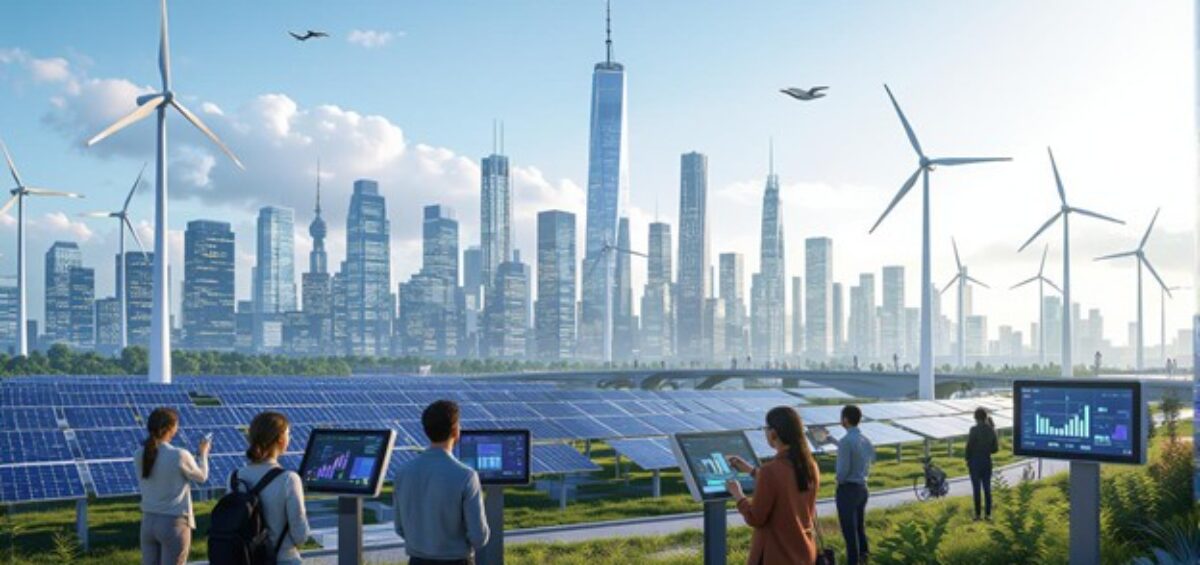
Solar and wind power are creating new industries, investment opportunities, jobs, and technological innovation while helping countries reduce dependence on fossil fuels.
But the transition itself also creates sustainability questions.
For example:
Who benefits from the new green economy?
What happens to workers and communities dependent on fossil-fuel industries?
Are the minerals required for clean technologies being extracted responsibly?
Is clean energy affordable and accessible?
These questions demonstrate why sustainability cannot be reduced to a single environmental indicator.
A technology may be environmentally beneficial in one respect while creating social or economic challenges elsewhere.
This is why sustainable development requires a systems-thinking approach.
If economic activity doubles, can resource consumption and environmental pressure also double?
The answer cannot simply be “yes.”
Sustainable development requires economies to become more productive while using resources more efficiently and reducing environmental harm.
Economic Growth vs. Sustainable Economic Development
These concepts are related, but they are not identical.
| Economic Growth | Sustainable Economic Development |
| Focuses primarily on increasing economic output | Focuses on long-term human and economic wellbeing |
| Often measured through GDP and related indicators | Considers economic, social, and environmental outcomes |
| Can occur without equal distribution of benefits | Emphasizes inclusion and shared prosperity |
| May increase resource consumption | Seeks resource efficiency and environmental sustainability |
| Often emphasizes quantity of production | Emphasizes quality and durability of development |
| Can focus on short- or medium-term gains | Emphasizes long-term outcomes and future generations |
The objective of sustainable development is therefore not to stop economic growth.
It is to make economic progress more inclusive, resilient, and environmentally responsible.
What Does This Mean for Businesses?
The same principle applies to organizations.
A business that increases revenue and profits while exhausting employees, damaging ecosystems, creating excessive waste, or ignoring communities may achieve short-term growth without creating sustainable value.
This is why businesses increasingly need to integrate Sustainable Business Practices into strategy and operations.
Sustainable businesses ask:
- How can we create long-term economic value?
- How can we reduce environmental impacts?
- How can we provide decent work?
- How can we support employee wellbeing?
- How can we create value for multiple stakeholders?
- How can we make our supply chains more resilient?
- How can we innovate without creating unnecessary environmental and social costs?
This broader perspective connects economic sustainability with the Triple Bottom Line, which considers people, planet, and prosperity together.
The Role of Human Resources in Sustainable Economic Growth
Economic sustainability ultimately depends on people.
Organizations need employees who can innovate, adapt, solve problems, and develop new approaches to sustainability.
This is where Sustainable Human Resource Management (Sustainable HRM) becomes particularly important.
HR can contribute to sustainable economic performance through:
- Ability-enhancing HR practices that develop employee knowledge and skills.
- Motivation-enhancing HR practices that encourage employees to contribute to organizational goals.
- Opportunity-enhancing HR practices that provide employees with opportunities to participate, innovate, and influence decisions.
These practices can help organizations develop human capabilities while simultaneously supporting social, economic, and environmental objectives.
The Real Challenge: Growth That Does Not Leave People Behind
The source material reaches an important conclusion: economic development can significantly improve people’s lives, but economic growth must be inclusive and environmentally sustainable if those gains are to endure.
This is perhaps the central challenge of sustainable development.
We need economic growth because millions of people still need better access to income, employment, healthcare, education, housing, energy, and other essentials.
But we also need to recognize that the planet has ecological limits.
Therefore, the goal is not simply:
More growth.
It is:
Better growth.
Growth that creates opportunity.
Growth that improves wellbeing.
Growth that supports innovation.
Growth that respects planetary boundaries.
Growth that can be sustained across generations.
Final Thoughts
Economic growth has delivered extraordinary improvements in human wellbeing. Higher incomes, better healthcare, longer lives, improved infrastructure, technological innovation, and expanding opportunities demonstrate that economic progress can transform societies.
But sustainable development asks us to go one step further.
Who benefits from growth?
What does growth cost society?
What does growth cost the environment?
Can today’s prosperity be maintained for future generations?
These questions transform economic growth from a simple measure of increasing output into a broader discussion about the kind of future we want to create.
The challenge of sustainable development is therefore not to reject economic progress.
It is to rethink progress itself—so that economic prosperity becomes inclusive, environmentally responsible, and capable of supporting human wellbeing over the long term.
That is the difference between simply growing an economy and building a sustainable economy.