



How Organizational Culture Drives Employee Engagement and Business Sustainability
A sustainable business is not built only through environmental targets, ESG reports, or financial performance. It is also built through the everyday culture that shapes how people work, communicate, collaborate, and make decisions. When organizational culture creates the conditions for employee engagement, engagement can become a powerful bridge between people and long-term business sustainability.
Organizations increasingly recognize that sustainability is not simply an environmental agenda. It involves balancing economic performance, social responsibility, and environmental stewardship while maintaining the organization’s ability to create value over time. Yet one critical question often receives less attention:
Keyword
- employee engagement, organizational culture and sustainability, business sustainability, organizational culture dimensions, leadership and employee engagement, internal communication and engagement, teamwork and employee engagement, rewards and recognition, employee support, economic sustainability, social sustainability, environmental sustainability, sustainable business practices, engaged employees.
Meta Description
Discover how leadership, communication, teamwork, support, and rewards shape employee engagement and how engaged employees fuel economic, social, and environmental sustainability.
What happens inside the organization that enables sustainability to become part of everyday work?
One answer lies in organizational culture.
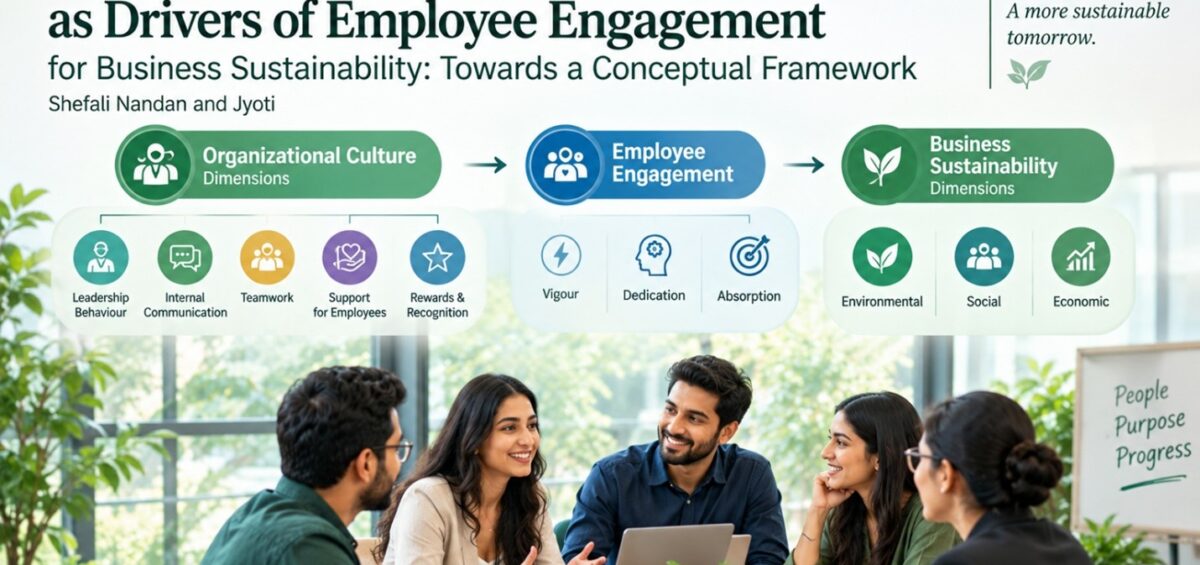
Research examining the relationship among organizational culture, employee engagement, and business sustainability identifies five particularly important cultural dimensions: leadership behaviour, teamwork, rewards, support for employees, and internal communication. These dimensions influence employee engagement, while engagement itself can contribute to economic, social, and environmental outcomes.
The implication for organizations is important: sustainability is not only something employees are asked to support; it is something organizational culture can enable them to practice.
Why Employee Engagement Matters for Sustainability
Employee engagement goes beyond employee happiness or job satisfaction. Engaged employees are psychologically connected to their work and organization. Schaufeli and colleagues describe engagement through three characteristics: vigour, dedication, and absorption.
Engaged employees tend to invest greater attention and energy in their responsibilities. The extant literature connects engagement with outcomes including employee performance, organizational achievement, customer satisfaction, productivity, and financial performance.
This matters for sustainability because sustainability requires more than policies written by senior management. It requires people throughout the organization to:
- identify problems,
- suggest improvements,
- collaborate across functions,
- use resources responsibly,
- support customers,
- manage risks,
- innovate,
- and connect everyday decisions with longer-term organizational goals.
In other words, engagement turns sustainability from an organizational intention into employee behaviour.
The source also emphasizes that engagement is not simply about making employees feel satisfied. It involves maintaining and strengthening employees’ involvement in their work and helping them contribute meaningfully to organizational goals.
Sustainability Has Three Dimensions
Business sustainability is commonly understood through three interconnected dimensions: economic, social, and environmental sustainability.
- Economic sustainability
Economic sustainability concerns an organization’s ability to generate value and maintain financial viability over time.
It includes considerations such as:
- profitability,
- productivity,
- cost efficiency,
- innovation,
- organizational resilience,
- reputation,
- and long-term value creation.
Economic sustainability is not simply about maximizing short-term profit. A business that achieves today’s financial target while undermining its workforce, reputation, resources, or stakeholder relationships may weaken its ability to create value tomorrow.
The source notes that sustainability-related practices can also influence reputation, employer brand, innovation, and competitive advantage.
- Social sustainability
Social sustainability focuses on people and society.
It includes issues such as:
- employee wellbeing,
- equality,
- fairness,
- respect,
- responsible treatment of stakeholders,
- community wellbeing,
- and concern for future generations.
Organizations increasingly operate under greater expectations from employees, customers, communities, and other stakeholders regarding responsible business behaviour.
This makes the workplace itself an important part of sustainability.
A company cannot credibly communicate social responsibility externally while consistently ignoring employee wellbeing, participation, fairness, or development internally.
- Environmental sustainability
Environmental sustainability concerns how business activities affect natural systems.
This includes issues such as:
- energy consumption,
- emissions,
- waste,
- pollution,
- resource efficiency,
- product life cycles,
- supply chains,
- and responsible use of natural resources.
Environmental responsibility increasingly extends across the entire product and service life cycle—from design and production through transportation, distribution, use, and disposal.
Employees are part of this process.
Whether an organization reduces waste, improves energy efficiency, redesigns processes, develops greener products, or identifies environmental risks, employees often influence whether sustainability initiatives succeed in practice.
Organizational Culture: The Hidden Infrastructure of Sustainability
Organizational culture can be understood as the shared beliefs, assumptions, values, and practices that give an organization its identity and influence how people behave.
Culture is expressed through what organizations reward, tolerate, communicate, prioritize, and model through leadership.
This is why sustainability cannot be separated from organizational culture.
A company may have a formal sustainability strategy, but employees learn what the organization truly values from everyday signals:
- What behaviour gets rewarded?
- Who gets promoted?
- Can employees challenge inefficient practices?
- Do managers listen to employee ideas?
- Is teamwork genuinely encouraged?
- Are sustainability goals included in performance discussions?
- Does leadership demonstrate the organization’s stated values?
- Can employees raise concerns without fear?
These cultural signals can either reinforce or undermine sustainability.
The source identifies five cultural dimensions that repeatedly emerge as important drivers of employee engagement:
- Leadership behaviour
- Internal communication
- Teamwork
- Support for employees
- Rewards and recognition
Together, they provide a practical starting point for building a culture that supports sustainable performance.
-
Leadership Behaviour: Sustainability Starts at the Top
Leaders establish the tone for organizational life.
Employees observe how leaders respond to problems, treat people, allocate resources, handle mistakes, recognize contributions, and make difficult decisions.
Research reviewed in the source identifies leadership as an important driver of employee engagement. Leaders who demonstrate genuine concern for employees, build trust, and provide appropriate support can create conditions that encourage greater engagement.
For sustainability, leadership therefore needs to go beyond communicating sustainability goals.
Leaders should model the behaviours they expect from others.
For example, if an organization promotes responsible resource use but senior leaders routinely ignore those practices, employees receive a conflicting message.
Likewise, if an organization encourages innovation but employees are punished whenever an experiment fails, the stated culture and lived culture are inconsistent.
A practical question for leaders
Instead of asking only:
“Have we communicated our sustainability strategy?”
ask:
“What behaviours are our leaders demonstrating that make sustainability credible?”
-
Internal Communication: Employees Cannot Engage With What They Do Not Understand
Communication is another important driver of engagement.
Effective internal communication helps employees understand organizational goals, expectations, feedback, and changes in the external environment. The literature reviewed in the source associates effective communication with engagement, innovation, organizational effectiveness, and awareness of organizational goals.
This has direct relevance to sustainability.
Employees need to understand:
- Why sustainability matters to the organization.
- What the organization is trying to achieve.
- What progress has been made.
- Where gaps remain.
- How their own roles affect sustainability.
- How they can contribute.
- Where they can raise concerns or propose improvements.
A sustainability strategy hidden in an annual report cannot create the same level of employee involvement as a strategy translated into everyday conversations.
Sustainability communication should therefore move in both directions.
Management communicates priorities downward, while employees communicate ideas, concerns, operational knowledge, and opportunities upward.
-
Teamwork: Sustainability Is a Collective Effort
Many sustainability challenges cross organizational boundaries.
Reducing waste may require cooperation between operations, procurement, finance, HR, and supply-chain teams. Improving employee wellbeing may require collaboration between HR, managers, health and safety teams, and senior leadership.
This makes teamwork an important cultural foundation.
The source notes that development-oriented teams can support employee growth and competence, while shared values, trust, collaboration, and clear expectations can strengthen engagement.
Teamwork also creates opportunities for employees to learn from one another.
A sustainability problem identified by a frontline employee may be invisible to senior management. A cross-functional team can bring together different perspectives and turn that insight into an operational improvement.
Sustainability question for teams
At the end of a project, teams can ask:
“What did we learn that could make our next decision more economically, socially, or environmentally sustainable?”
That simple question can help embed sustainability into organizational learning.
-
Support for Employees: Sustainable Organizations Need Sustainable Workplaces
Employee support is another important cultural dimension.
Research reviewed in the source links organizational and supervisor support with outcomes including job satisfaction, wellbeing, organizational commitment, and engagement.
This is particularly important because employees cannot be expected to sustain organizational performance indefinitely if the workplace systematically undermines their wellbeing.
Support can take many forms:
- appropriate resources,
- supportive supervisors,
- development opportunities,
- manageable workloads,
- psychological support,
- flexibility where appropriate,
- career development,
- recognition,
- and opportunities to participate in decisions.
This connects directly with social sustainability.
A sustainable organization should therefore ask not only whether its environmental footprint is improving, but also whether the way it organizes work supports people over the long term.
-
Rewards and Recognition: What Gets Rewarded Gets Repeated
Employees pay attention to what organizations recognize.
Rewards may be financial or non-financial. Recognition, constructive feedback, incentives, development opportunities, and acknowledgement of contributions can reinforce desired behaviours and support engagement.
This creates an important opportunity for Sustainable HRM.
If organizations want sustainability to become part of everyday behaviour, they can recognize contributions such as:
- reducing operational waste,
- improving resource efficiency,
- developing sustainable products,
- supporting colleagues,
- mentoring others,
- improving customer outcomes,
- identifying social or environmental risks,
- and proposing sustainability innovations.
The objective is not to turn every sustainability activity into a bonus scheme.
Rather, organizations should ensure that their reward systems do not contradict their sustainability values.
For example, rewarding employees solely for short-term sales volume may create different incentives from a strategy that emphasizes long-term customer relationships, responsible selling, or sustainable value creation.
The Missing Link: Employee Engagement
The five cultural dimensions do not operate independently.
Leadership influences communication.
Communication influences understanding.
Teamwork creates opportunities for participation.
Employee support strengthens wellbeing and commitment.
Rewards reinforce desired behaviours.
Together, these conditions can influence employee engagement.
And engagement can become the mechanism through which organizational culture affects sustainability.
A useful way to visualize the relationship is:
Organizational Culture
↓
Leadership | Communication | Teamwork | Employee Support | Rewards
↓
Employee Engagement
↓
Economic Sustainability | Social Sustainability | Environmental Sustainability
The source’s conceptual framework brings these relationships together, proposing that organizational culture dimensions influence engagement and that engagement contributes to business sustainability.
Why Engagement Makes Sustainability More Credible
There is an important distinction between communicating sustainability and embedding sustainability.
An organization can publish sustainability commitments, produce reports, and launch environmental campaigns. But if employees are disconnected from those commitments, sustainability may remain primarily a communication exercise.
Employee engagement changes the equation.
Engaged employees can participate in sustainability through their everyday work:
- suggesting process improvements,
- reducing unnecessary resource use,
- identifying risks,
- improving customer experiences,
- supporting colleagues,
- innovating,
- and helping translate organizational values into practice.
The source reviews evidence linking employee engagement with outcomes including productivity, customer loyalty, employee retention, financial outcomes, environmental participation, and stakeholder value.
This does not mean that engagement automatically produces sustainability. Rather, the literature suggests that engagement can be an important pathway through which organizational practices contribute to broader sustainable outcomes.
The Sustainable HRM Connection
This relationship has particular relevance for Sustainable Human Resource Management (Sustainable HRM).
Traditional HR systems often focus on recruitment, performance, compensation, training, and retention.
Sustainable HRM asks a broader question:
How can HR practices help an organization create value for people, the organization, and society over the long term?
From this perspective, employee engagement should not be treated as an isolated HR metric.
It can be connected to:
- sustainable leadership,
- employee wellbeing,
- learning and development,
- green HRM,
- employee participation,
- responsible performance management,
- sustainable rewards,
- organizational resilience,
- and stakeholder value.
HR therefore has an important role in translating sustainability from a corporate strategy into the employee experience.
A Practical Sustainable Culture Checklist
Organizations do not need to redesign their entire culture overnight.
They can begin by examining five questions.
- Leadership
Do leaders consistently model the sustainability values they communicate?
- Communication
Do employees understand the organization’s sustainability goals and how their roles contribute?
- Teamwork
Do employees have opportunities to collaborate on sustainability-related problems and solutions?
- Employee support
Does the organization provide the resources, wellbeing support, development, and psychological conditions employees need to perform sustainably?
- Rewards
Do performance and reward systems reinforce—or undermine—the organization’s sustainability priorities?
These questions can be incorporated into employee surveys, leadership reviews, HR audits, sustainability assessments, and departmental planning.
From Employee Engagement to Sustainable Business
The central lesson is straightforward:
Sustainability is not created only by strategies. It is created by people operating within systems and cultures that make sustainable behaviour possible.
Organizational culture shapes those systems.
A culture characterized by supportive leadership, effective communication, teamwork, employee support, and appropriate recognition can create stronger conditions for employee engagement. Engaged employees, in turn, can contribute to organizational performance, stakeholder relationships, environmental responsibility, and social outcomes.
The literature reviewed by Nandan and Jyoti brings these relationships together by connecting organizational culture, employee engagement, and the three dimensions of business sustainability.
For HR leaders, the message is particularly relevant.
If an organization wants sustainability to become part of how work gets done, it should not begin only with another sustainability policy.
It should also examine its culture.
Because ultimately, the question is not simply:
“What is our sustainability strategy?”
It is:
“What kind of workplace enables our people to make that strategy real?”
Key Takeaway
Organizational culture can provide the social infrastructure for sustainability. Leadership, communication, teamwork, employee support, and rewards influence employee engagement, while engaged employees can contribute to economic, social, and environmental outcomes.
For organizations pursuing long-term sustainability, people and culture are not peripheral to the sustainability strategy—they are part of how the strategy becomes operational.
Reference:
Nandan, S., & Jyoti. (2020). Organizational culture dimensions as drivers of employee engagement for business sustainability: towards a conceptual framework. In Sustainable Human Resource Management: Transforming Organizations, Societies and Environment (pp. 109-132). Singapore: Springer Singapore.
Jaganjac, B., Hansen, K. W., Lunde, H., & Hunnes, J. A. (2025). The role of organizational culture and structure in implementing sustainability initiatives. Business Ethics, the Environment & Responsibility, 34(4), 1239-1254.