


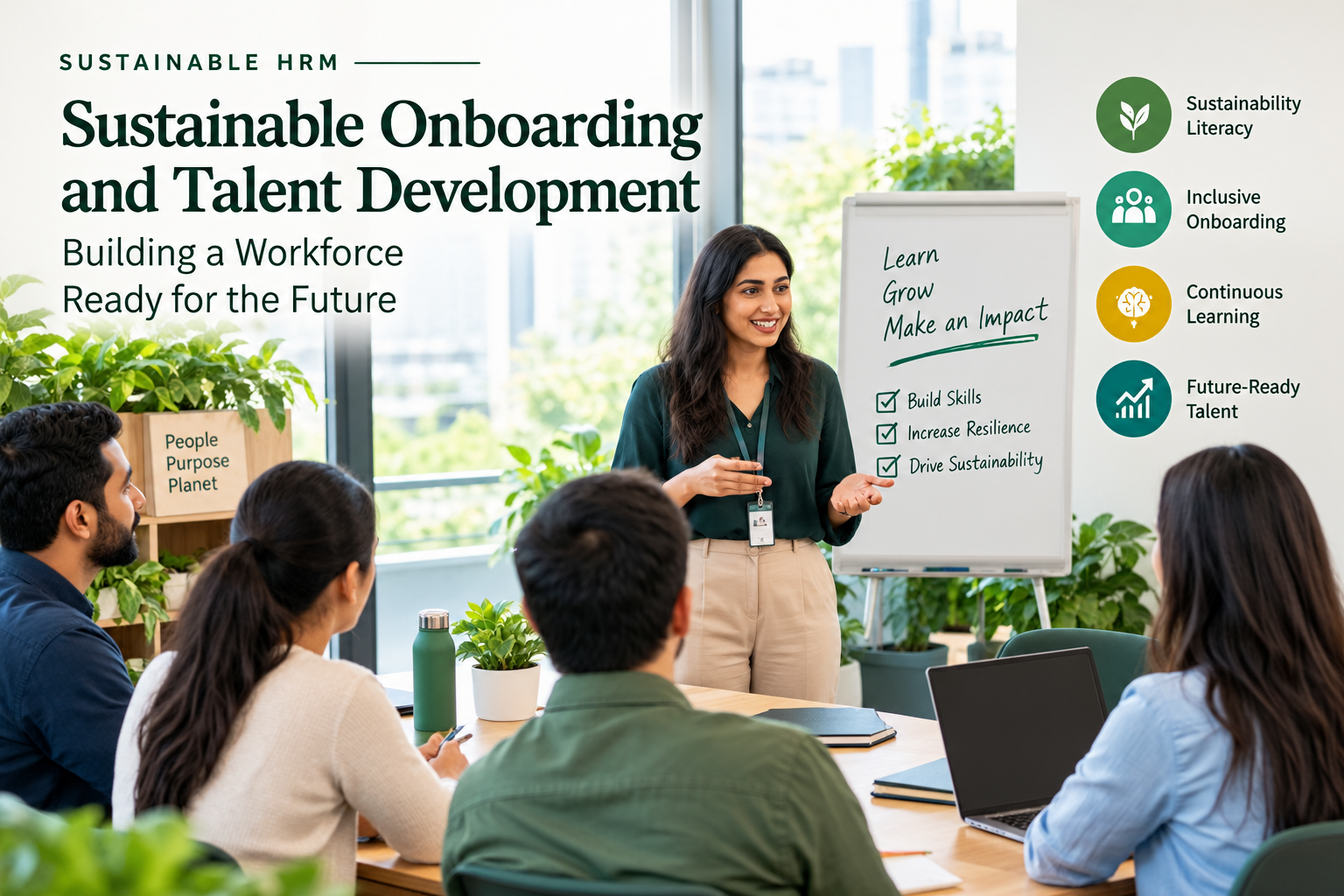
Sustainable Onboarding and Talent Development: Building a Workforce Ready for the Future
Organizations often describe their employees as their most valuable asset. Yet when financial pressure increases, training and development budgets are frequently among the first areas to face cuts.
This creates a fundamental question for Sustainable Human Resource Management (Sustainable HRM):
Should employee development be viewed as a cost to control—or as a long-term investment in organizational resilience and sustainability?
The answer has important implications for how organizations onboard, develop, and retain their people.
Sustainable HRM looks beyond immediate training returns. It considers whether organizations are continuously building the capabilities they need to adapt to technological change, environmental pressures, changing regulations, and evolving stakeholder expectations.
The Training Budget Dilemma
Imagine a mid-sized insurance company facing pressure to reduce costs. The CFO proposes cutting the annual training budget by 40% because the training department cannot demonstrate a clear quarterly return on investment.
Buried within the proposed cuts, however, is a two-year sustainability upskilling program.
The program has already trained 60% of the company’s underwriters in climate-risk assessment—a capability increasingly relevant to the organization’s core insurance activities.
The question for HR is not simply whether training costs money.
The more important question is:
What capabilities will the organization need tomorrow, and what will it cost if those capabilities are not developed today?
This is one of the central challenges of Sustainable HRM.
From Short-Term ROI to Long-Term Capability Building
Training has a structural disadvantage in traditional cost-cutting exercises.
Its costs are visible today, while many of its benefits appear later.
A training program has immediate costs:
- Trainer fees
- Employee time
- Learning materials
- Technology
- Travel and facilities
But its benefits may emerge over months or years through:
- Improved decision-making
- Greater adaptability
- Reduced skill shortages
- Internal mobility
- Innovation
- Employee resilience
- Better responses to environmental and regulatory change
This creates a tension between short-term financial measurement and long-term organizational capability.
Sustainable HRM does not mean that every training program should automatically receive funding. Poorly designed training can waste resources.
Instead, it requires HR to ask a more strategic question:
Does this investment build capabilities that help the organization remain adaptable and sustainable over time?
Onboarding: The First Opportunity to Build Sustainability Literacy
Sustainability education should not begin after employees have spent years in an organization.
Onboarding is one of the earliest opportunities to establish how sustainability is understood and practiced within the organization.
New employees are learning the organization’s expectations, values, systems, and ways of working. This makes the onboarding period particularly important for communicating sustainability commitments.
However, sustainability onboarding should not simply consist of a presentation about the organization’s sustainability vision.
It should answer a much more practical question:
What does sustainability mean for my job?
A warehouse employee, finance analyst, HR professional, engineer, marketer, and salesperson may all contribute to organizational sustainability in different ways.
Effective onboarding therefore connects sustainability to the employee’s actual role.
What Should Sustainable Onboarding Include?
A sustainability-oriented onboarding process can include four important elements.
-
Explain the Organization’s Real Sustainability Position
Employees should understand the organization’s specific sustainability commitments.
Importantly, organizations should communicate not only what has been achieved but also what remains unfinished.
This creates a more credible understanding of sustainability than presenting an organization as having already solved every challenge.
-
Connect Sustainability to the Employee’s Role
Employees need to understand how sustainability affects their own decisions.
For example:
A finance employee may contribute through sustainability-related reporting and investment decisions.
A procurement employee may influence supplier selection.
A production employee may contribute to waste and energy reduction.
An HR professional may influence employee wellbeing, inclusion, learning, and sustainable employment practices.
Sustainability becomes more meaningful when employees can see the connection between their daily work and broader organizational goals
-
Create Channels for Employee Ideas and Concerns
Sustainability should not be presented as the responsibility of a specialist sustainability department alone.
Employees should know where they can raise sustainability-related concerns, propose improvements, and identify problems.
This turns sustainability from a top-down communication exercise into a participatory process.Establish Personal Sustainability Goals
Onboarding can also encourage employees to identify a specific contribution they can make during their first 90 days.
This creates a bridge between:
Organizational sustainability → Employee role → Individual action
Continuous Learning and Workforce Resilience
Onboarding is only the beginning.
Sustainable HRM views continuous learning as an investment in workforce resilience.
Organizations increasingly operate in environments shaped by automation, digital transformation, changing regulations, climate-related risks, and evolving customer expectations.
The skills required today may not be sufficient tomorrow.
This makes learning agility increasingly important.
Learning agility refers to the ability to learn from experience and apply that learning to new and unfamiliar situations.
Rather than asking only:
“What skills does this employee have today?”
organizations increasingly need to ask:
“How capable is this employee of learning what the organization will need tomorrow?”
Reskill or Replace?
Technological and environmental transitions often create new skill requirements.
When an existing role changes or disappears, organizations can broadly consider two approaches:
Replace: Let existing employees go and recruit people with the required skills.
Reskill: Invest in existing employees so they can transition into new roles.
Sustainable HRM places significant emphasis on reskilling where operationally viable.
The reason is strategic as much as social.
Existing employees possess organizational knowledge, relationships, experience, and familiarity with organizational systems. These forms of knowledge can take years to develop.
Replacing employees may therefore solve an immediate skills problem while creating a longer-term loss of organizational knowledge.
The Interface Example: Learning as a Sustainability Capability
Interface Inc. provides an instructive example of the connection between sustainability and employee development.
Its Mission Zero commitment required more than a leadership statement. Employees across manufacturing operations needed to understand sustainability objectives and participate in changes designed to reduce environmental impacts.
Rather than treating sustainability education as a one-time training program, Interface developed continuous education and employee participation around sustainability over an extended period.
An important feature of this approach was employee participation.
Employees received training related to sustainability measures relevant to their work while also being encouraged to suggest improvements in areas such as waste, energy, and material use.
This can be understood through the AMO framework:
- Ability: Provide employees with the knowledge and technical skills required to contribute.
- Motivation: Recognize employees for useful sustainability ideas.
- Opportunity: Give employees channels through which their ideas can influence decisions.
This demonstrates an important principle of Sustainable HRM:
Employees do not become sustainability capabilities simply because an organization gives them sustainability training. They become a capability when knowledge, motivation, and opportunities to act come together.
When Training Becomes Mere Compliance
Not all training contributes equally to organizational sustainability.
In highly regulated industries, training may sometimes focus primarily on satisfying compliance requirements.
Compliance training can be necessary. However, if employee development stops there, organizations may miss the broader benefits of capability building.
There is a difference between:
“Employees completed the required training.”
and
“Employees developed capabilities that help the organization adapt, innovate, and solve emerging problems.”
Sustainable talent development aims for the second outcome.
Building a Sustainable Talent Pipeline
Organizations should therefore think about talent development as a long-term system rather than a collection of individual training programs.
A sustainable talent pipeline asks:
- What capabilities will we need in the future?
- Which capabilities already exist internally?
- Where are our skill gaps?
- Which employees could be reskilled?
- How can onboarding build sustainability literacy?
- How can continuous learning support organizational resilience?
- Are our development budgets aligned with our stated sustainability commitments?
This approach changes the role of HR.
HR becomes not merely a provider of training but a builder of organizational capability.
A Practical Five-Session Sustainability Onboarding Model
Organizations looking for a practical starting point can structure sustainability onboarding around five sessions:
Session 1 — Organizational Context
Introduce the organization’s sustainability commitments, current progress, and acknowledged gaps.
Session 2 — Role Relevance
Explain how the employee’s specific role connects to sustainability-related decisions.
Session 3 — Systems and Channels
Show employees how to raise sustainability ideas, concerns, and observations—and who is responsible for responding.
Session 4 — Sustainability in Practice
Discuss a real organizational sustainability trade-off or decision and invite employees to consider different perspectives.
Session 5 — Personal Goal Setting
Ask each new employee to identify one sustainability-related contribution they can make during their first 90 days, followed by a discussion with their manager.
This approach makes sustainability part of the employee’s work experience rather than simply another orientation presentation.
The Strategic Role of HR
Sustainable HRM requires HR professionals to think beyond the annual training budget.
The real issue is not simply:
“How much are we spending on training?”
It is:
“What organizational capabilities are we building, and will they remain valuable as the business environment changes?”
An organization that continuously develops its people may be better positioned to respond to technological, environmental, and regulatory disruption without relying exclusively on external hiring or workforce reductions.
At the same time, sustainable talent development requires discipline. HR should be able to identify priorities, evaluate outcomes, and demonstrate how development investments contribute to organizational objectives.
Final Thought
Sustainability is not achieved through policies and targets alone.
It also depends on people who have the knowledge, skills, motivation, and opportunity to turn those commitments into action.
That is why onboarding and talent development belong at the heart of Sustainable HRM.
The organizations preparing for the future are not only asking:
“What skills do we need today?”
They are also asking:
“What capabilities must we build now to remain resilient tomorrow?”
Sustainable talent development is ultimately about creating a workforce capable of learning, adapting, and contributing to long-term organizational sustainability.
Investing in people is not separate from sustainability. For many organizations, it is one of the ways sustainability becomes possible.